WiFi Radio

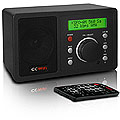
I love this little WiFi radio I received just yesterday from C. Crane. Sure, I could just as easily use one of my computers to listen to any of the nearly 50,000 audio streams listed on Reciva.com, but I’d have to install a Real player to get many of them, and given Real’s history of annoying software, that’s something I’m not willig to do. Besides, there’s just something nice about having a separate device. I guess my old brain just thinks it’s radio because it comes from something that looks like one. I like that I can just turn it off and on again, and after the requisite few seconds of “buffering…”, I’m listening to one of my favorite stations. No application to start. No window to move around on my monitor. Just a box with familiar knobs and buttons.

Again, nothing revolutionary about the content, but I’ve already re-connected with Stan Dunn and others who now produce In the Spirit of KJAZ. It’s still the great sound of KJAZ that went off the air 14 years ago. And I can listen to WNYC2, albeit from a tiny speaker so the HD experience is lost. Although I spend most of my time here in an office/studio with a lot of high-end audio gear, I don’t bother to pipe the WiFi Radio’s line output through the fancy speakers. So far, I like the non-imposing little-box sound. Yeah, it makes no sense to me, either. Go figure.

The Beijing Story We Don’t Hear

http://p.castfire.com/Xu7m0/video/22252/bbtv_2008-08-22-010603.flv
Videobloggers Jay Dedman and Ryanne Hodson have been posing as tourists in Beijing for the past ten days, but actually turning their cameras towards the Free-Tibet protests that have been so aggressively squashed by the Chinese government. Xeni Jardin managed to interview Jay and Ryanne on a Skype video call and published it on Boing Boing TV. [full story]

Data Centers by the Truckload

When I started a web-hosting company back in 1995, we used bakery racks to hold Sun servers — mostly ES-450s, as I recall. The first real Internet data centers were then based on the designs of the telco industry, starting at 100 watts/sq ft, working their way up to 300 watts/sq ft for fairly dense server farms. Air conditioning was usually the biggest problem. As server densities increased, many aging data centers were only able to use a portion of their floorspace because they couldn’t supply enough cooling for the newer servers. As expensive as they were, it was very hard to design and build a data center that would be able to handle the increased densities five years down the road. Looking back only 13 years later, we had no idea how steep the scale curve would become.

Now, as Ina Fried reports at cnet, Microsoft (and I assume others) are buying servers not by the box or even by the rack, but pre-assembled and fully networked in shipping containers with densities of thousands of watts/sq foot. They have to. They’re adding 10,000 servers a month. They don’t repair or replace individual servers when they fail. They just monitor the total number of working servers in the container. When some percentage of the servers have failed, they yank the entire container and send it back to the supplier for refurbishing. Or, if the technology has improved, a container can simply be replaced with one that has even more-densely packed servers. (I assume that that each container has its own air conditioning and just requires water in/out.)

With densities like this, the big guys (Google, Microsoft, Yahoo, etc.) are primarily in the electrical-power business. In some cases, they’re even building (or planning to build) their own generating facilities. It only took a decade to get to this point. Hard to imagine how we’ll be building data centers in another ten years.

A Net-Neutrality Victory

Here’s another big one. The FCC gets it. They’ve delivered a thrashing to Comcast. Professor Lessig wrote a five-page response [pdf] to the Commissions three-page summary [pdf] of their 34-page order [pdf]. We won’t know for a few months the extent to which Comcast complies or digs in their heels, but this is not only a round for the good guys, it also puts into federal print a good precendential explanation of the issues. Just having this order on the record will help make the case for net neutrailty as the battle rages on. [source: Lessig]

Having lived through the transition starting with the Carterfone decision, it’s easy to understand how important this is to innovation.

Audacity’s Auto Duck

A “ducker” is an audio tool (traditionally hardware, but now also in software) that reduces the level of one track when there’s a signal on another track. It’s very common in talk shows, where you want the host of the show to have priority and override the voices of guests. A ducker is extremely useful for cleaning up two-track interview recordings, such as those from Skype.

As of release 1.3.3 (currently in beta), the open-source audio package Audacity has included an “Auto Duck” feature, which could be quite helpful if you record/edit two-track interviews, particularly from phone calls or Skype.

Fulfillment by Amazon

I’m experimenting with Fulfillment by Amazon. So far, so good. Seems to be run with the same quality of infrastructure as Amazon Web Services and the rest of Amazon.com. For a limited time — not sure how long — we’re offering my most-recent book, Loosely Coupled, The Missing Pieces of Web Services, at a 50% discount. You should see the $19.99 price from RDS Press. Let me know whether the fulfillment and delivery meet your expectations.

Cirque du Soleil in Las Vegas

Okay, so this has nothing to do with the topics I usually blog about, but I happen to be here in Las Vegas for the New Media Expo this week. I took advantage of the trip and brought my wife along with the enticement of seeing two Cirque du Soliel shows. Even if you’re not a Cirque fan, this is for you.

There are actually six very different Cirque du Soleil shows Las Vegas, and I’d guess the most-popular one is ‘O‘, although ‘Love‘ may have taken over that honor. We saw ‘Love’ tonight. It’s essentially a typical Cirque du Soleil show based on the music of the Beatles in a huge theatre. This isn’t your typical circus-in-a-tent show like the traveling Cirque du Soleil. Shows like these can’t ever tour — the theatres are essentially built uniquely for them. Perhaps the best part of ‘Love’ is that they’ve absolutely perfected the techniques of flying people around a large theatre at high speeds on wires, trapeze and bungee. It’s not just dramatic, it’s also incredibly graceful. Overall, the show is a bit confusing, and I think it’s fair to say that perhaps it emphasizes the psychedelic aspects of the Beatles’ lives and music. The show is extremely trippy, and as my wife agreed, I wouldn’t be surprised if lots of people come stoned. There’s so much going on at once, it can be difficult to know what to watch.

If I’d only seen ‘Love’ while here in Las Vegas, I wouldn’t be writing this post. The reason I’m blogging is the Cirque du Soleil show we saw last night: ‘‘. I’d never heard of it before. I bought the tickets only because I couldn’t get them for ‘O’. But I’ve got to say, ‘KÀ’ is one of the most amazing theatrical events I’ve ever seen. (Note: My wife and I are both former drama majors.) The starting point for ‘KÀ’s greatness can be summarized in one word: hydraulics. It’s in a massive theatre, seating maybe 4,000 people. The proscenium is perhaps 80-100 feet high. But the major element of the set is a fully articulated platform that’s something like 40×60 feet. Maybe even larger. The platform starts out at floor level, but imagine your flatscreen TV with one of those VESA mounts on the rear with an arm that allows it to be turned and twisted in three dimensions. Then imagine it flipping vertical (or even past vertical), loaded with a cast of dancer/acrobats. Effortlessly and silently, it becomes the size of a six-story building. Two of the most amazing scenes are performed in this vertical position. This photo of one of those scenes doesn’t really do it justice. The wall is, in fact, vertical and the performers are not wired. I won’t even try to describe some of the uses of this platform. And don’t think it’s gimmicky — it’s not. The set and staging would be way over-the-top in other contexts, but it all works seamlessly here. The video trailer also undersells the show.

Don’t get me wrong. This isn’t just about a set design. Everything about this show is superb, cast included. Lighting, sound, music, choreography (martial arts including Capoeira) — all superb. It’s been running for a year, two shows/day five days/week, which means over two million people have seen it. But I think it’s Cirque du Soleil’s sleeper show here. If you’re going to Las Vegas and can afford the tickets, this is the show I’d recommend.

Update: Here’s a trailer on YouTube that shows a bit more. Think of “martial arts meets steampunk.” Wikipedia says the platform is 25×50 feet and weighs 50 tons. Writing in the New York Times, Steve Friess called it “Metrolpolis meets Blade Runner” and says the theatre cost $135 million to construct and holds 1,950 seats.
Free Licesnes Upheld

As Larry Lessig says, this is huge.

…the [Court of Appeals for the Federal Circuit] has held that free licenses such as the CC licenses set conditions (rather than covenants) on the use of copyrighted work. When you violate the condition, the license disappears, meaning you’re simply a copyright infringer. This is the theory of the GPL and all CC licenses. Put precisely, whether or not they are also contracts, they are copyright licenses which expire if you fail to abide by the terms of the license.

A big step forward for validation of Creative Commons and GPL licenses. Congratulations to all who fought for this for the rest of us.

Road Trip

It’s time to take The Conversations Network mobile. That means two things: (1) a lightweight version of the website design suitable for all mobile browsers, and (2) an iPhone 2.0 dedicated application. The former has been on the to-do list for some time, and the number of requests has been growing steadily. The latter is (for now) just for fun, but I’d love to see what could be done. We need help for both projects.

Question: What’s the latest/best standard for mobile apps? What flavor of XML/HTML, etc? I’m so out of touch on this. The last thing I remember dabbling with was WAP when developing for mobile devices was brand new. Where should I look to ramp-up on developing for mobile browsers?

Opportunity: I don’t have the personal bandwidth to get up-to-speed on iPhone development, but if anyone wants to volunteer to create an iPhone app for The Conversations Network, I’ll gladly handle the back-end development.

AIR: And I’d also love to see an application for The Conversations Network based on Adobe AIR. From the few AIR apps I’ve used to date, I’ve been impressed with the UI as well as the cross-platform installation and update processes.