I haven’t tested it yet, but there’s a lot of buzz about SILK, a new high-quality voice codec for Skype. If it’s as good as the gossip suggests, it’s going to invalidate some of the information in our Skype for Interviews video.
Author: Doug
Using Kampyle.com
A few weeks ago we started using an online service, Kampyle.com, for all The Conversations Network’s web sites including SpokenWord.org. Kampyle.com is one of those services like Google Analytics and ShareThis.com: They do one relatively small thing and they do it very well. In the case of Kampyle.com, it’s website or application-software feedback. On SpokenWord.org, for example, you’ll notice the yellow triangle that always floats in the lower-right corner of your browser. Click it, and you get a convenient form for sending us feedback, reporting a bug, etc. From the user’s perspective, it couldn’t be much easier. But the real magic is on our side. For example, here’s just some of the metadata we get from Kampyle.com when you report a problem:
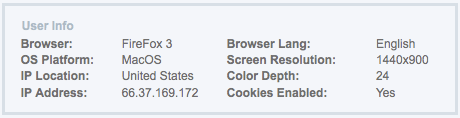
For debugging a web site, this is invaluable. It typically saves us at least one complete email exchange with someone reporting a problem. No longer do we have to ask, “What OS and browser are you using?” Given that we’re still at the stage where we have a fair number of JavaScript and CSS problems, this alone has made deploying Kampyle.com worthwhile. In fact, I was initialy concerned that adding a floating widget to our pages would itself create CSS nightmares, but my fears have proven unfounded. We’re not getting ay complaints about it. And ever since we added the Kampyle.com widget, our website feedback has increased about 400%. I only wish we’d had it avaialble during our alpha-test. Very cool.
Podiobooks
We just added the entire audiobook catalog from Podiobooks.com to SpokenWord.org. That picked up 6,087 chapters from 284 books, with more being added every day. You’ll find one of the most-recent Podiobooks on our home page or you can browse the entire collection. Special thanks to Ray, Evo, Chris and Tee for creating a great site and for making it so easy to pull in their catalog.
Preliminary Survey Results
We’ve only been running our annual survey for a few days, but we’ve already had 389 responses. Some early highlights:
- 47% use iTunes on OS X or Windows.
- 63% subscribe to one or more of our RSS feeds.
- 89% are male.
- 41% have a Master’s degree or higher. (This has been consistent year after year and still surprises me.)
- 55% are in the U.S.
- 38% didn’t realize The Conversations Network was a 501(c)(3) nonprofit.
Everything (!) About Recording Phone Calls
When it comes to information about audio recording hardware, software and techniques, no one does it better than Jeff Towne, the tools editor at Transom.org. Their microphone shootouts, for example, have become true classics. Now Jeff is back with another “everything you every wanted to know about” article on Recording Phone Calls. As always, extraordinarily thorough. Destined to become another online classic.
The Conversations Network Annual Survey
If you listen to The Conversations Network’s channels or have visited SpokenWord.org, we need your help. Please take ten minutes and answer the questions in our annual survey. Not only will your answers help guide our future directions, your demographic information will also help us convince underwriters to support our non-profit efforts.
On Technometria
My most in-depth discussion yet about SpokenWord.org has just been published on Technometria with Phil Windley and Scott Lemon. As the show’s description below suggests, we also got into a discussion of many of the programming challenges of this project.
Doug Kaye joins Phil and Scott to discuss the recently launched SpokenWord.org, a free service that helps you find, manage and share audio and video spoken-word recordings. In addition to giving a basic description of the site, Doug also discusses the technical aspects of the project, including how it was developed and what kind of challenges he is facing now that it is operational.
SpokenWord.org: Open to the Public

Visualization courtesy wordle.net.
SpokenWord.org: An Interview
Chuck Joiner just published an interview with me on his MacVoices podcast about SpokenWord.org.
SpokenWord.org: Open to the Public
 The day is finally here. No more excuses. No more alpha or beta. It’s time to open the doors. SpokenWord.org is ready for prime time and ready for you.
If you’re a regular reader of Blogarithms, you’re probably tired of hearing about SpokenWord.org, but if you’re a newcomer, here’s a portion of the press release:
There are perhaps millions of audio and video spoken-word recordings on the Internet. Think of all those lectures, interviews, speeches, conferences, meetings, radio and TV programs and podcasts. No matter how obscure the topic, someone has recorded and published it on line.
But how do you find it?
SpokenWord.org is a new free on-line service that helps you find, manage and share audio and video spoken-word recordings, regardless of who produced them or where they’re published. All of the recordings in the SpokenWord.org database are discovered on the Internet and submitted to our database by members like you.
SpokenWord.org has been ten months in the making, and like any such undertaking there are many people who contributed to its successful launch. I’d like to use this opportunity to thank just some of them and tell a bit of the story behind SpokenWord.org.
In April 2008 we held meetings of our Board of Advisors and Board of Directors in Cambridge, Massachusetts. It was approaching the fifth anniversary of IT Conversations, and hence a good opportunity to review our mission. In the early days (more than a year before the birth of podcasting) we had no choice but to do everything ourselves — recording, post-production and publishing — and we were virtually alone on the Web. But today there are tens of thousands of podcasts, and it’s now de rigueur for conferences to post their audio and video recordings on line. Add to that the podcasts from public radio and universities, and it’s clear that anyone can now be a publisher. Looking at the big picture of spoken-word content on the Internet, the greatest need (and hence the potential for the greatest public benefit) has shifted from production and publishing to helping people find, organize and share the programs published by others. That is why we created SpokenWord.org.
Present at that seminal meeting were directors Jake Shapiro, Jon Udell, David Weinberger and advisors Dan Bricklin and Bob Lyons. The big Aha! came from Jon, who has continued to be an incredible inspiration to the project. Jon also introduced me to Lucas Gonze and Hugh McGuire, both of whom have graciously given me the benefit of their been-there/done-that experience.
Finally, I want to thank the active alpha testers who not only succeeded in breaking everything I wrote, but were also kind enough to provide the constructive criticism that got us to the version 1.0 release. Most notable among the nearly 100 active testers were David Marks, Bruce Sharpe, Steve Williams, Ken Kennedy, Joel Tscherne, Rashmi Sinha and Thilo Planz. (I feel like I’m delivering an Oscar acceptance speech and they’re trying to get me off the stage.)
Working with this awesome team of advisors has made this project one of tremendous personal satisfaction. I hope you enjoy the results of our efforts.
 Blogarithms